
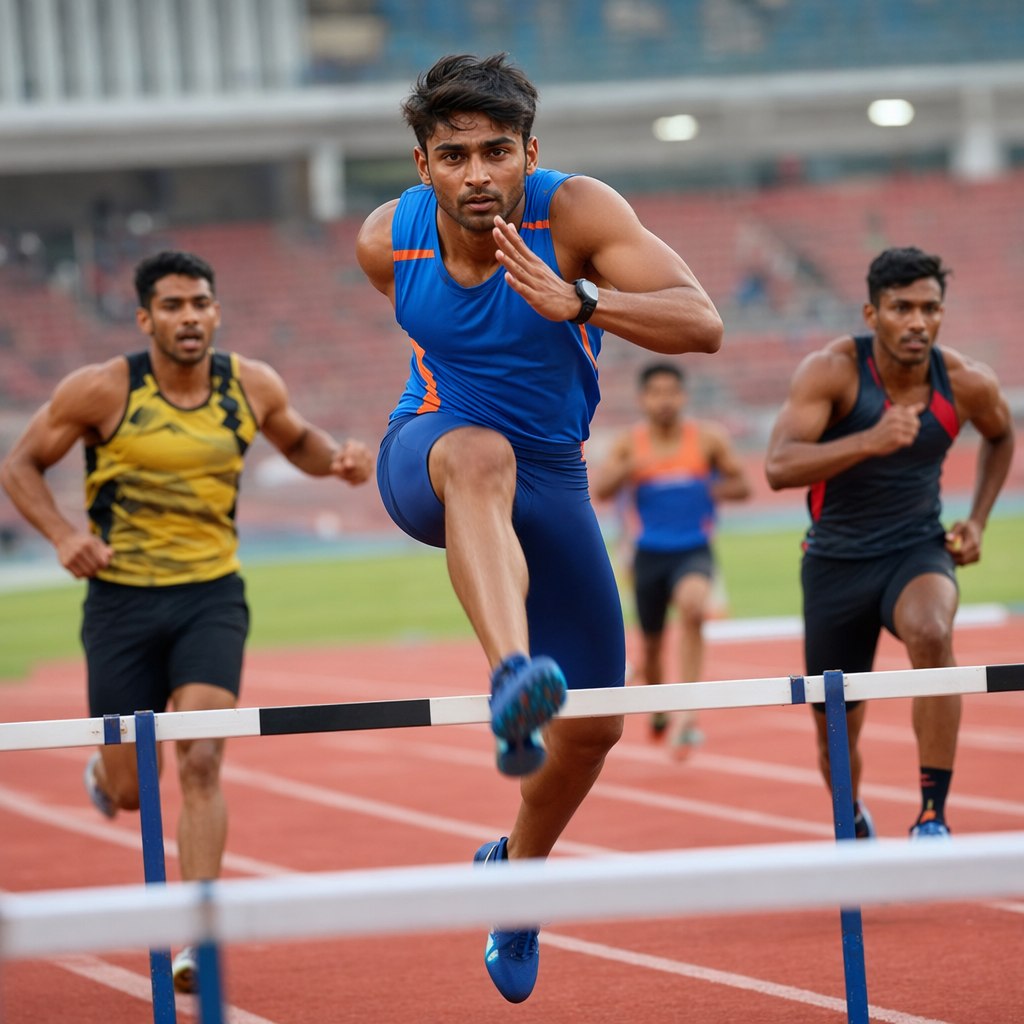
India’s national record-holder Tejas Shirse endured a painful finish to a landmark Commonwealth Games 2026 outing, running the men’s 110m hurdles final with a navicular stress fracture in his left foot and placing eighth and last. Shirse, 24, had made history earlier by becoming the first Indian to qualify for the event’s final at the Commonwealth Games, but his hopes of building on that breakthrough were derailed by an injury sustained during warm-up.
Shirse had clocked 13.76 seconds in the heats to secure his place in the final. A few hours later, he suffered the stress fracture and faced a decision: withdraw or attempt the race. He chose to compete, running with a heavily taped foot, and finished in 15.39 seconds. After crossing the line, he was seen grimacing in pain and hobbling off the track.
Historic qualification, then a warm-up setback
Shirse’s qualification for the final was a significant moment for Indian hurdling at the Commonwealth Games. His 13.76 in the heats was enough to progress under the competition’s advancement rules, with the first three in each heat and the next two fastest moving through to the final.
However, the final took a dramatic turn before it even began. Shirse said he sustained a navicular stress fracture in his left foot during warm-up. Rather than pulling out, he asked his physiotherapist to tape the foot so he could take his place in the final.
“In the warm-up, I suffered a navicular stress fracture in my left foot. I didn’t want to pull out, so I told my physio to tape it,” Shirse told PTI.
He explained that the significance of being the first Indian to reach the Commonwealth Games final in the 110m hurdles influenced his decision to run despite the injury. “I am the first Indian to qualify for the 110m hurdles final at the Commonwealth Games, so I didn’t want to let the whole nation down by pulling out,” he said.
Race run through pain
Once the race started, Shirse said the pain quickly became overwhelming. He indicated that after the opening hurdle he realised his chances of competing at his best were effectively over, even though he managed to complete the race.
“I thought I would stop after the first hurdle, but the adrenaline was so much that I could complete the race. But the moment I crossed the first hurdle, I knew it was gone. I am not able to put pressure on it at all,” he said.
Shirse’s final time of 15.39 seconds left him eighth in the eight-man field. Following the finish, he struggled to walk while speaking to reporters, underlining the severity of the discomfort he was dealing with immediately after the race.
What Shirse said next and the season context
After the final, Shirse described the injury as a recurrence rather than a new issue, and said it was too early to know what it might mean for his upcoming plans. He noted that he would need scans before any clear assessment could be made, including whether it could affect his participation at the Asian Games in September-October.
“This is not a new injury. It had happened earlier also. I will have to get scans first and then see,” he said.
Reflecting on his performance earlier in the day, Shirse said he believed he had more to offer before the injury struck. “My heat was okay. My body had become cold. It was not the best performance. I know there was a lot more in the tank. I did warm up for the final but it didn’t go as per plan,” he said.
Shirse’s broader season form has included a standout mark: his season’s best of 13.27 seconds, which is also the national record. That time came at the Indian Athletics Series 9 in Ludhiana last month, highlighting the level he has shown in 2026 even as his Commonwealth Games final ended in disappointment.