
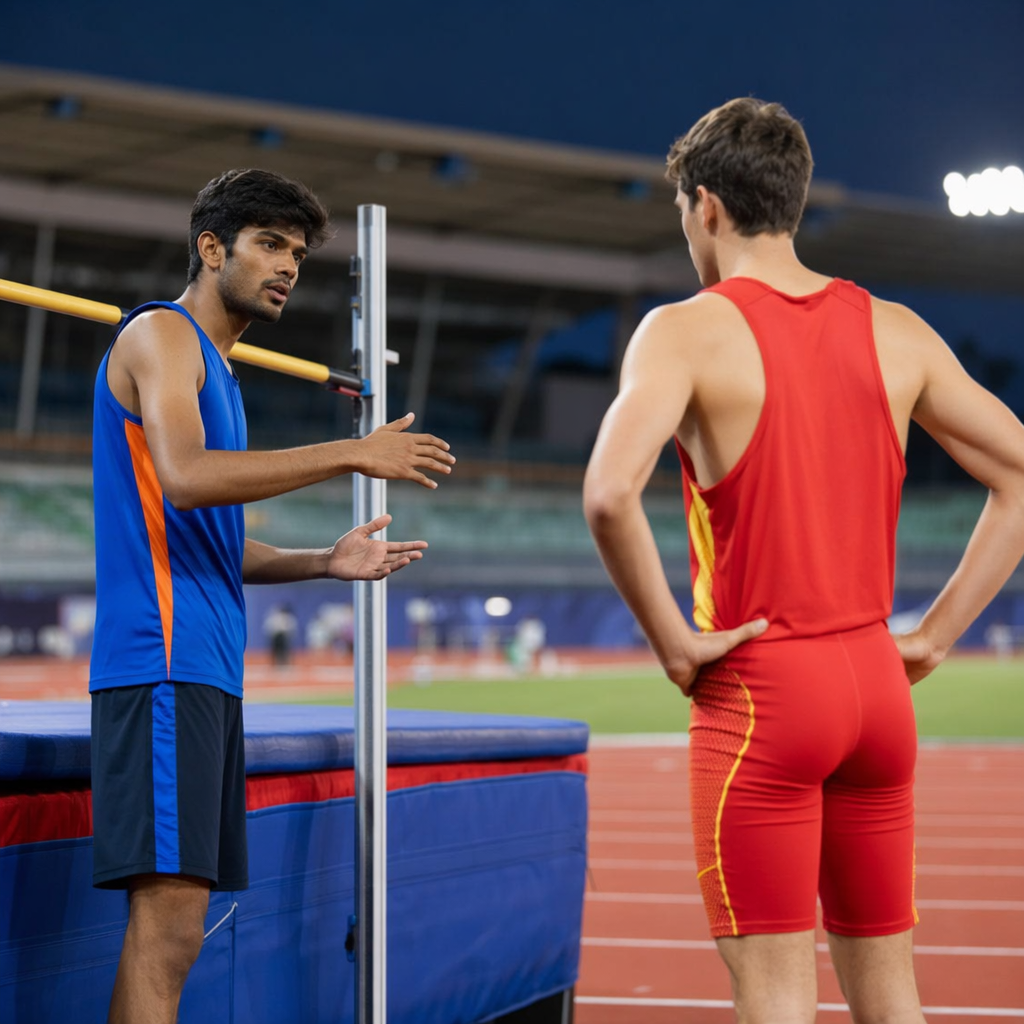
Tejaswin Shankar’s Commonwealth Games men’s high jump campaign in Glasgow ended before it could properly begin, but the Indian athlete still played a decisive role in the event by staying back to help compatriot Sarvesh Kushare secure the silver medal.
Shankar, 27, suffered a sharp knee pain during his warm-up on Monday and could not continue after clearing his first attempt. Despite the disappointment and visible emotion, he remained at the venue and switched into a support role, offering technical input that Kushare later credited as crucial in turning his competition around.
The moment mattered for India not only because Kushare’s silver bettered Shankar’s own Commonwealth Games high jump bronze from Birmingham 2022—India’s first-ever medal in the event—but also because it showed how Shankar’s experience still influenced the outcome even after injury forced him out.
How Shankar’s advice helped Kushare regain rhythm
Kushare said he began shakily and struggled to find his usual flow at a key height. He explained that he wanted to clear heights on his first attempts, but his rhythm faltered during his effort at 2.25m.
“I wanted to clear the height in my first attempt itself, but during 2.25m my rhythm was affected and my stride became shorter. Then TJ told me to move forward in my run-up, and that helped,” Kushare said.
That adjustment, suggested by Shankar from the sidelines, proved important in helping Kushare settle and continue his push that ultimately ended with a silver medal. While Shankar’s own competition was derailed, his presence remained a factor in the final outcome through the practical, technical guidance he provided.
After the event, Shankar was visibly emotional as he spoke about the injury that ended his high jump hopes on the day. “I felt a shooting pain in my knee. It happened during my warm-up. It’s nothing new; I have always had tendonitis in my knees,” he said.
He added that the issue is common among high jumpers. “I don’t think there is any high jumper who doesn’t have it. That’s why it’s called jumper’s knee. Everyone manages it, and so do I,” he said.
Shankar also described the timing as especially painful, saying he had arrived in Glasgow believing he was in medal-winning shape. “But it’s one of those days. You want just one day in a year when you don’t have that pain, but it came on that day only. It really stings. In these conditions, I was really confident I could jump for a win, jump for a medal. I really knew I could win a medal,” he said.
He underlined how difficult it was to be stopped so early. “But to not even get through the first height, it stings because I was in really great shape,” Shankar said, before explaining the nature of the problem: “It’s just overuse of the patellar tendon. There is nothing spectacular about it. It just flared up today and ruined my entire competition.”
Shankar targets decathlon return after knee flare-up
Even as he processed the disappointment of his high jump exit, Shankar said he remained hopeful of being able to compete in the decathlon, which begins on Thursday.
“I will come back in two days. We still have two days. I’ll give my best over the next two days and try and fix this. I will obviously start. I’m not here on vacation,” he said.
Shankar noted the specific challenge posed by the patellar tendon in events that place heavy load on it. “The patellar tendon is used in high jump and long jump, so if I’m somehow able to get by those two events, I’m still confident the other events will be fine,” he said.
Shankar is India’s national record holder in the decathlon and has won an Asian Games silver along with two Asian Championships medals in the discipline. He is also the first Indian to cross the 8000-point mark in the 10-event competition.
For now, Glasgow’s men’s high jump story carried two intertwined threads: Kushare’s silver medal, and Shankar’s decision to stay and help even after his own injury ended his bid—an act Kushare said made a tangible difference when it mattered.