
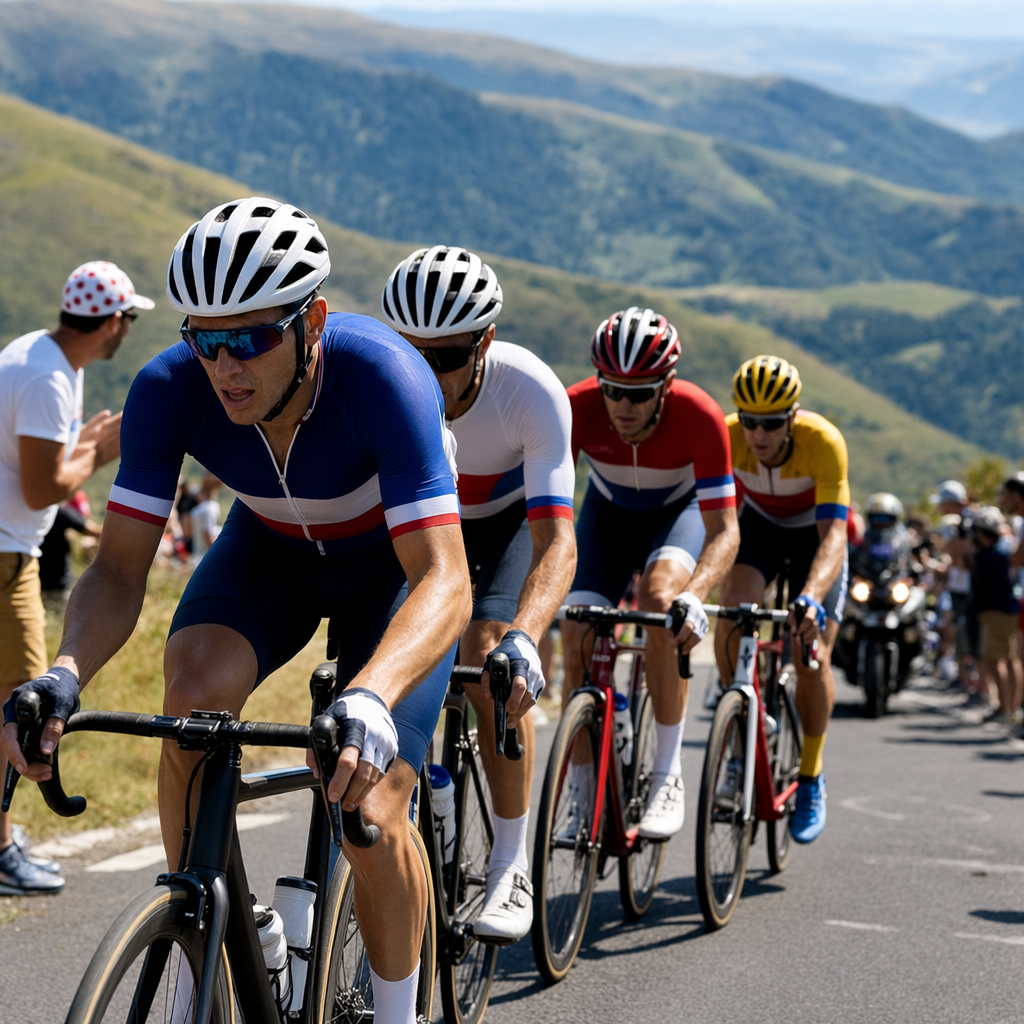
Tour de France 2026 returns to the Massif Central on Tuesday for Stage 10, a 166.6km route from Aurillac to Le Lioran that revisits the scene of Tadej Pogačar’s narrow defeat to Jonas Vingegaard in 2024. With the stage coming straight after the rest day and falling on Bastille Day, UAE Team Emirates-XRG expect an unpredictable day of racing across constantly changing terrain, seven classified climbs, and a finale that can suit either a breakaway or a GC showdown.
UAE’s head of racing Joxean Fernández Matxin said the team uses the rare stages Pogačar didn’t win as “a source of extra motivation,” framing the 2024 Le Lioran outcome as something they can draw positives from rather than fear. The Slovenian’s team also insist that any strategy will only become clear once the stage is underway, even with Pogačar holding a 2:42 advantage on GC at this point of the race.
Why Le Lioran matters again for UAE and the GC battle
Le Lioran carries recent Tour history. In 2024, Pogačar attacked late while in yellow, then eased up—reportedly due to a hunger knock—before Vingegaard caught him and beat him in a sprint at the line. The moment felt like a turning point at the time, echoing earlier Tours where Vingegaard ultimately prevailed, even though 2024 ended with Pogačar taking his third overall victory.
Two years on, UAE are balancing that memory against a more recent reference point: the largely symbolic tussle at La Plagne last year, when Vingegaard outsprinted Pogačar for second place despite being more than four minutes down. Matxin argued that even if a similar sprint played out again, it would not necessarily define the long-term fight for yellow—especially with the race already feeling heavily tilted in Pogačar’s favour.
Matxin’s message is that UAE do not intend to race defensively even with a favourable GC situation. He pointed to the broader dynamics behind the overall classification: riders sitting five or eight minutes down can still influence the battle for the podium, and the gaps are “not unbridgeable.” That mix of ambitions, he suggested, makes a stage like this harder to control and harder to predict.
The course design adds another layer. The single intermediate sprint comes before the stage’s seven mostly punchy climbs, which Matxin said can complicate the fight to form the breakaway because sprinters may also be interested in the points on offer. In his view, the day’s winning move is often decided early: “80% of the day’s victory is in the first part of the stage and getting into the break, then 20% is what happens afterwards.”
There is also heat to consider. The preview notes that maximum temperatures of 36°C are expected on exposed roads, with the hottest conditions set to persist for now even if they ease later in the race.
Stage 10 route: Aurillac – Le Lioran (166.6km)
Stage 10 features non-stop changes of rhythm typical of the Massif Central, with the bulk of the climbing packed into the final two-thirds of the day. None of the climbs are described as excessively difficult on their own, but the repeated efforts are expected to sap strength and create opportunities for time gaps.
The classified climbs are: Côte de Pailherols (cat. 3, 3km at 7.2%, km 68), Col de la Griffoul (cat. 2, 5.9km at 6.7%, km 97.3), Col de Prat de Bouc (cat. 3, 3.1km at 6.5%, km 103.8), Côte de Murat (cat. 3, 5.2km at 5.3%, km 118.8), Puy Mary-Pas de Peyrol (cat. 1, 7.8km at 6%, km 135.7), Col de Pertus (cat. 1, 4.4km at 8.5%, km 152.1), and Col de Font de Cère (cat. 3, 3.1km at 5.8%, km 163.9).
The intermediate sprint is at Lacapelle-del-Fraisse (km 25.5). The stage starts at 13:10 CET and is scheduled to finish at 17:24 CET.
What to watch: breakaway vs GC fireworks on Bastille Day
The preview underlines how the same terrain can produce radically different outcomes. In 2016, Greg Van Avermaet won at Le Lioran from a breakaway with more than two minutes in hand. In 2024, the day ended with GC fireworks and a sprint between Vingegaard and Pogačar. With the stage placed immediately after the rest day and on Bastille Day—when, as Pogačar noted, “a lot of French riders will be wanting to win because of the day”—either scenario could return.
Matxin also highlighted how stage design can amplify gaps even after the hardest climbs are done. With two first-category ascents followed by an easier third-category climb and then a rolling run-in, he argued that time differences can grow rather than shrink, depending on who can sustain the effort after the steepest sections. For UAE, that uncertainty is part of the challenge: they say they have “lots” of rivals to watch, and that while Pogačar has taken an important step, “it’s not at all definitive” with a long Tour still ahead.