
Dilip Mahadu Gavit delivered a landmark moment for Indian para athletics at the Commonwealth Games 2026, winning gold in the men’s 100m T47 final as India sealed a historic one-two finish. Gavit clocked a Games record and season-best 10.71 seconds to take the top spot, while Mohammed Basil Morssinganakath secured silver with his season-best 10.83 seconds in a closely fought race.
England’s Kevin Santos completed the podium, taking bronze in 10.85 seconds. The result mattered beyond the medals: it underlined India’s growing strength in para athletics on a major multi-sport stage and added to the country’s overall medal momentum at the Games.
Games record sprint on a rain-soaked track
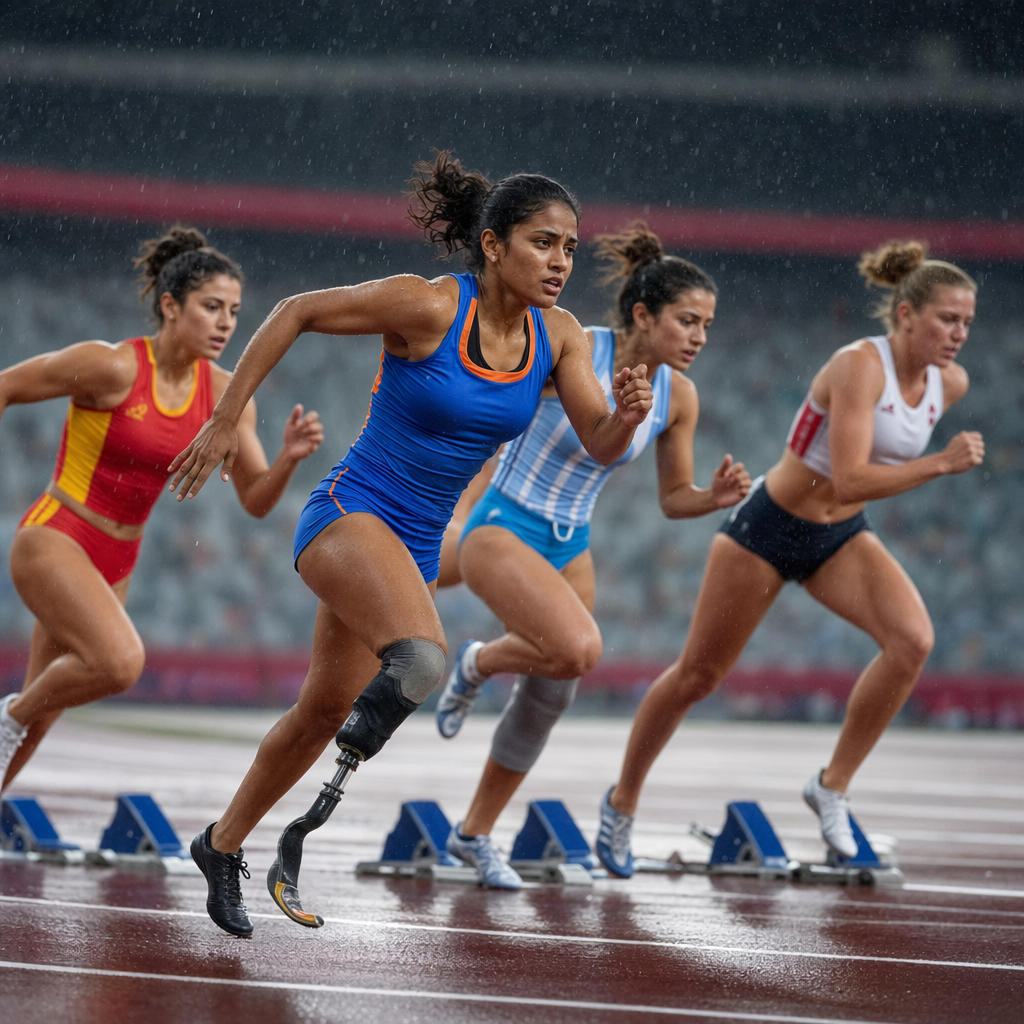
The men’s 100m T47 final was contested in difficult conditions, with the race held on a rain-soaked track. Despite the challenge, Gavit produced the fastest time of the field, setting a Games record while also registering his best time of the season.
After the race, Gavit acknowledged that his start was not ideal, but said he built into the sprint as it progressed. “The start was a bit slow, but then I gradually picked up pace and it felt great to win,” he said.
He also pointed to the impact of the weather on preparation and rhythm. “The weather was not good and I had difficulty getting my timing right. The body becomes slow and it is difficult to warm up,” he said.
Basil’s silver medal came with a season-best 10.83 seconds, keeping the pressure on through the finish in what the report described as a closely fought race. Santos followed close behind with 10.85 seconds for bronze, underlining how narrow the margins were in the final.
The men’s 100m T47 is a para athletics sprint event for athletes with a unilateral arm impairment or absence, affecting strength, movement or coordination on one side.
India’s third gold and a standings boost
Gavit’s win was India’s third gold medal at the Glasgow Commonwealth Games. It followed Mirabai Chanu’s victory in the women’s 48kg weightlifting event and Sharmila Dhankar’s triumph in the women’s shot put F57 para athletics category.
The two medals in the 100m T47 final helped lift India to eighth spot in the standings, with a tally of three gold, nine silver and three bronze.
From rural Maharashtra to Commonwealth Games champion
Behind the gold medal was a journey shaped by adversity, limited facilities, and a key intervention from his coach. Gavit was born in a rural area of Maharashtra and lost his left hand after medical facilities were unavailable at the time.
With limited access to training infrastructure in his hometown, athletics initially seemed an unlikely route. His coach, Vaijanth Kale, said he first noticed Gavit’s potential at school and then persuaded his parents to support training. “I saw him at school and then I convinced his parents for training,” Kale said after the triumph.
Kale added that Gavit’s early competitive experience came in able-bodied events, not para competitions. “He did not know anything about para competitions. He was competing in able-bodied events and was doing well,” he said.
Before moving into para athletics, Gavit had already recorded results against able-bodied competitors, winning two medals at the Khelo India Youth Games in Pune and another medal at the Under-18 level. Kale said the lack of facilities in rural areas remained a major challenge during Gavit’s development, while also referencing the circumstances that led to the amputation. “He would do well in able-bodied meets. The problem in rural areas is that there are no facilities. He did not get proper medical facilities, which led to his left hand being amputated,” Kale said.
Training in Nashik helped Gavit take his career forward, and the Commonwealth Games gold now stands as the biggest result of that progression so far.
Even after the historic win, Gavit indicated he is focused on what comes next rather than easing off. “I am not thinking about doing a job now, my target is to win medals,” he said. Looking ahead, he added: “I am sure I will do better at the upcoming Para Asian Games in September-October in Japan and then the Paralympics.”