
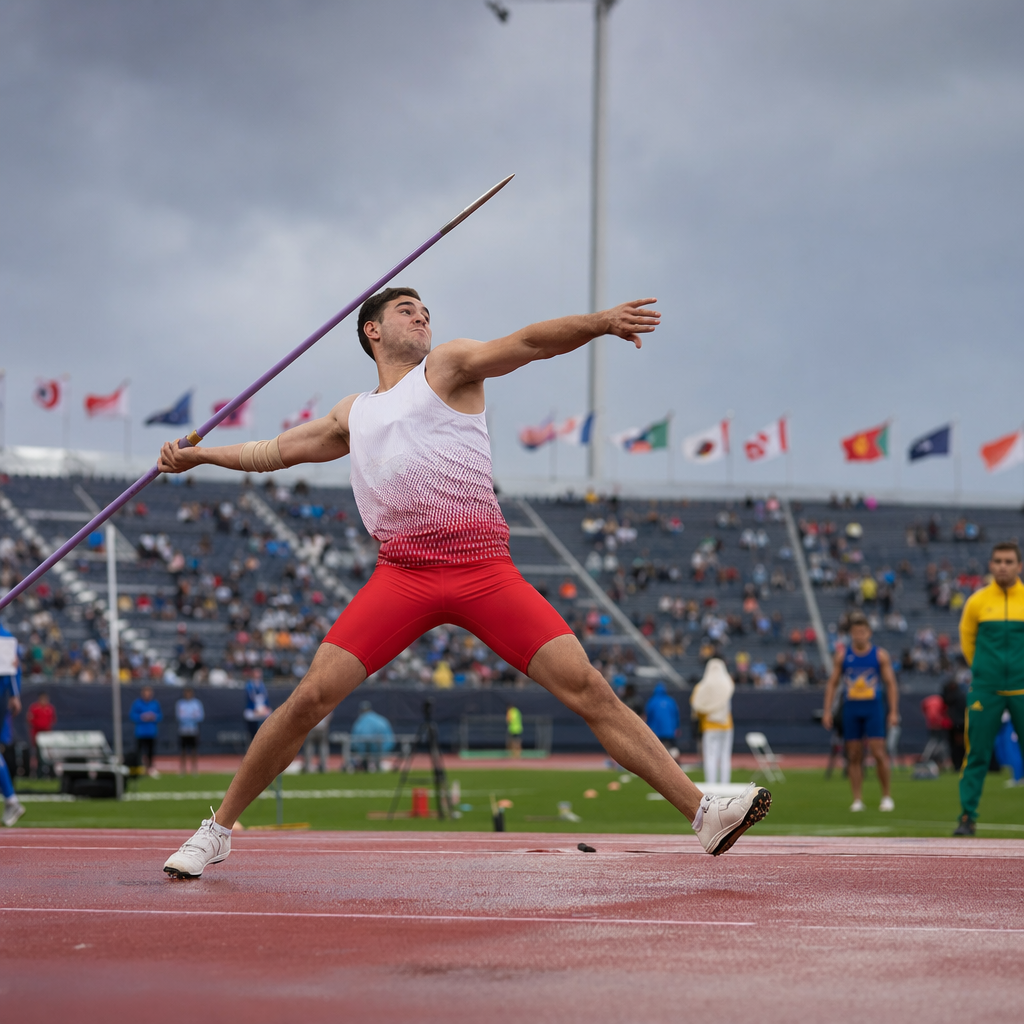
No athlete managed to breach the 84-metre automatic qualification mark in the men’s javelin throw qualification round at the Commonwealth Games 2026 on Thursday, with difficult wind conditions in Glasgow playing a decisive role. Despite the unusual low distances, big names including Neeraj Chopra and Arshad Nadeem still progressed to the final.
The qualifier produced a surprising pattern: even champion throwers who have previously cleared 90 metres were unable to find their usual range, and several struggled to cross even 80 metres. While holding back in qualification can be common, the expectation was that at least one athlete would reach the 84m standard. Instead, the automatic mark went untouched.
What happened in the men’s javelin qualifier
Chopra’s series underlined how tricky the session was. His first attempt measured 76.28 metres, before he improved in his second attempt to 79.61m, which left him fifth overall and meant he did not need a third throw.
Nadeem, described as Chopra’s long-term rival, recorded a best of 78.63 metres, which came on his first attempt. That distance placed him seventh overall in the qualification round.
Only four athletes were able to clear the 80-metre mark in the qualifier: Sri Lanka’s Rumesh Tharanga Pathirage, Grenada’s Anderson Peters, South Africa’s Douw Smit, and England’s Ben East. Even with those efforts, none of the field reached the 84m automatic qualification standard.
The overall outcome stood out because the qualification featured multiple elite throwers, including Chopra, Nadeem, Peters, and Pathirage, yet the distances remained compressed and below expectations across the board.
Chopra on the conditions
Chopra pointed directly to the weather and wind as the key factor behind the unusual results. “Conditions were not the best for javelin throwers-not only cold, but windy. And the wind was not from the front. It’s very hard to process. Sometimes I thought I’d throw a certain way, but the wind would come from another side. A lot of throwers were struggling. Nobody hit the automatic qualification,” he said.
Why the 84m automatic mark went untouched
The primary reason cited for the lack of automatic qualifiers was the presence of strong winds at the venue in Glasgow. The conditions were described as treacherous for throwers because crosswinds disturbed the flight of the javelin, making it harder to control direction and achieve peak distance.
It was reported that athletes faced a 13 km/h west-blowing gust as they tried to secure qualification for the men’s javelin final. With the wind not consistently coming from the same direction, throwers were forced to adjust on the fly, and the field collectively struggled to produce the kind of clean, stable flights typically needed to push beyond 84 metres.
Even so, the key takeaway from the qualification round is that the headline names are still through to the final, despite a session in which the automatic standard proved unreachable for everyone in the competition.